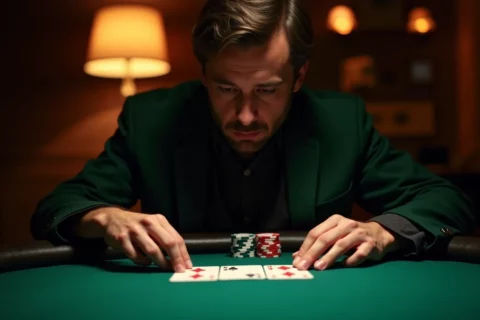

A stack is the only thing at the table that keeps telling on its owner while they sit there pretending to be anonymous. A clean 100 big blinds usually says less about courage than about plumbing, auto top-up, and habit. A weird number like 73.4 big blinds says somebody lost a pot, refused to refill, bought in for a reason, or is guarding a fixed bankroll like it is the last glass of water in the desert.
Chip counts are session history, bankroll mood, and strategy preference squeezed into one number. If you can read stacks as a running biography, you stop treating every avatar like it came from the same factory.
Stack archaeology starts before the first hand
The first entry in the notebook is the starting stack. A player who sits with the table max, or very close to it, is usually setting up for deep-stack play or simply using auto top-up without thinking about it. A player who sits with 40 big blinds, 75 big blinds, or some awkward slice like 73.4 is already telling you something. Sometimes it is a short-stack specialist. Sometimes it is a recreational player who does not want to risk the whole deposit. Sometimes it is just someone who has not reloaded after taking a hit.
The number alone does not solve the case. The pattern around the number does.
A player entering with 100 big blinds and instantly topping back to 100 after a loss behaves very differently from a player who drifts down to 73.4 and stays there. The first profile usually cares about maintaining effective stack depth. The second profile often cares about not feeling the loss again. One is playing a system; the other is protecting a balance.
Two forty big blind stacks are not the same thing
Mathematically, 40 big blinds is 40 big blinds. In practice, that stack can belong to two people who should be treated as different species.
One player may have chosen 40 big blinds on purpose. They know the lines, they know the push-fold spots, and they are comfortable operating in a narrower decision tree. Against loose lineups or high-rake pools, a rehearsed short-stack strategy can be a deliberate weapon. This player reloads without drama and keeps the machine running.
Another player may be sitting on 40 big blinds because they are trying not to torch the last visible piece of a recent deposit. They fold more, call too much in the wrong spots, and start treating every pot like a personal finance crisis. Same stack size. Different brain.
That split helps you decide whether to pressure them pre-flop, size up post-flop, or simply leave them alone until the table gives you a better target. A systematic 40 big blind player is looking for EV, while a deposit-protecting 40 big blind player is looking for relief.
Top-up habits tell the cleaner story
Stack archaeology gets sharper once the cards start flying. The most revealing detail is not the stack size itself but what happens after the stack changes.
Instant reloads to a full stack usually point to a disciplined grinder or a player who wants their decisions anchored to one effective stack depth. They lose a pot, refill, and keep playing the same game. That is a serious habit because it removes a lot of the emotional noise from the session.
Delayed reloads tell you something else. So do partial reloads. So does the player who clearly avoids the refill button and lets the stack sink. Those players are often more attached to the current session result than to long-run strategy. They do not want to re-enter the same emotional spot. They want the pain to stay small.
Watch what happens between hands as well. A player who appears with a bigger stack than before, without playing a pot at the table, may have moved chips over from another table. That can be a sign of a winning session elsewhere, or simply disciplined chip management. A player who comes back smaller than before may have bought down, cashed out, or started pruning risk after a run-up. That is a useful tell. Players who start trimming exposure mid-session are rarely the loosest, bravest bodies in the pool.
Large pots expose stack psychology
Willingness to play big pots is the last layer of the read. Some players will happily commit a big portion of their stack with a hand and a plan. Others start flinching as soon as the pot turns serious, especially when their stack has already thinned out.
If a player keeps entering large pots while sitting on a middling stack, they may be comfortable with variance, or they may simply be playing a compressed strategy where stack commitment is part of the script. If the same stack size comes with panic folds, under-repped strength, and sudden caution, you are probably looking at someone trying to preserve what is left rather than maximize EV.
The stack off frequency also matters. Some players treat all-in spots like a normal cost of doing business. Others avoid them like they owe them money. That difference shows up fast once the board gets wet and the bet sizing gets real.
A simple hand tells the story
Picture a cutoff open from a player sitting on 73.4 big blinds. The avatar says nothing. The stack says plenty.
If that player arrived with 100, lost a pot, and never topped up, the 73.4 looks like a damaged stack in a live session. If they bought in for 73.4 from the start, the number could be deliberate. They may be protecting a fixed cash amount. They may be experimenting with a mid-stack setup. They may be a grinder who does not want to auto reload mid-session.
Now compare that to the player across the table who has been at 100 all night, gets clipped to 86, and is back at 100 before the next hand is dealt. Same room, same stake, different priorities. The first player is showing attachment to the current chips. The second is showing attachment to the method.
Use the biography, not the avatar
Stack reading helps you choose targets. A player with odd starting stacks, irregular reloads, and shrinking commitment to big pots is often softer than the avatar suggests. They are more likely to fold marginally, defend passively, and dislike pressure when their stack looks exposed.
A player who always sits full, always reloads full, and keeps firing into large pots is harder to bully and usually closer to a real strategy. They deserve respect until their line breaks.
The table gives you all of this in plain sight. Start with the first stack, track the top-ups, note the buy-in size, and watch who leans into pots and who starts nursing chips like a wounded asset. Most players think their cards are their story. The stack is usually a cleaner autobiography.