
A 60% VPIP over twenty hands is not a read. It is a weather report from five minutes ago, delivered by someone who controls the window you are allowed to look through. Poker rooms that ban third-party tracking while serving up their own statistics do not eliminate information asymmetry. They replace the open market of data with a state-run bodega where they stock the shelves, set the prices, and decide what goes out of date.
The disciplined player learns to shop there anyway, but never trusts the inventory.
What the House Shelves Actually Stock
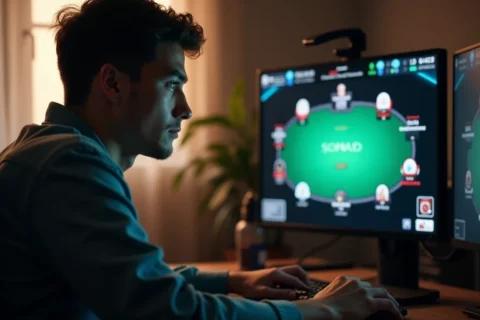
CoinPoker and GGPoker both run this model, though their implementations differ. CoinPoker bolts a basic HUD directly onto the table and enforces its monopoly with bans on external overlays. GGPoker splits the function: Smart HUD hovers in-session with categorical labels like “Fish” or “The Rock,” while PokerCraft waits in the background as a post-session review tool. Neither room permits hand-history conversion or data mining that would let players build independent databases.
The metrics these systems surface are deliberately narrow. You will see VPIP, PFR, 3-bet frequency, fold to 3-bet, c-bet percentage, and fold to c-bet. These population-level descriptors are useful for sorting players into broad buckets: loose-passive, tight-aggressive, the standard zoo. You will not see turn c-bet frequency, river fold-to-pressure rates, or positional 3-bet splits. The rooms have decided that granularity is a privilege they will not extend, and this absence is a strategic fact.
The Three Time Bombs in Curated Data
Every built-in statistic carries a temporal problem that the operator created and does not solve.
Sample size distortion is the first. Twenty hands is not a trend. A player running hot with premium starting cards can post a 60% VPIP that collapses to 22% over the next hundred. The HUD does not flag this uncertainty. It presents the number with the same visual weight as a thousand-hand sample, and players conditioned to trust on-screen data treat both as equally valid.
Recency windows create the second trap. Session-only stats catch tilt in real time, which is genuinely useful. They also catch variance, adjustment experiments, and table-specific dynamics that mean nothing for the player’s baseline. A regular testing a looser button strategy for two hours becomes a temporary “whale” on your display. Conversely, lifetime averages blend the current sharp player with their loose-passive phase from eighteen months prior. The HUD shows neither the trajectory nor the date of the data’s origin.
Strategic invisibility is the third and most expensive. A player who studied solver outputs last month and tightened their calling ranges against river aggression has made a profitable adjustment. Your HUD, drawing from older hands, still paints them as a calling station. You value-own yourself for three buy-ins before the label catches up, if it ever does.
Reading the Reader, Not the Dashboard
The counterplay is to treat built-in statistics as hypotheses rather than verdicts, then spend the session trying to falsify them.
Watch bet sizing first. A player whose HUD shows moderate aggression but who pots every value hand and min-raises bluffs has telegraphed a split strategy that no aggregate percentage captures. Note it immediately. Timing tells come next: the snap-call that confirms a calling station, or the tank-fold that contradicts a “Fish” label on GGPoker’s display. The player who pauses before folding is thinking, and thinking players are rarely the type their VPIP suggests.
Position-specific behavior is where the HUD goes fully blind. Open K9s from early position when the display shows a tight 15% VPIP, and you have discovered a sample size lie or a recent strategic shift. Either way, the number is wrong for this decision. Cross-reference post-flop lines against the HUD’s c-bet percentage. A low c-bet stat combined with frequent double-barreling means selective, dangerous aggression rather than blanket passivity. That distinction changes how you defend, and no built-in display will surface it for you.
Active note-taking becomes essential in this environment. “3-bets light from button,” “folds to turn pressure,” “overplays top pair” — these observations compound over time into a player-specific file that outlives any session-bound statistic. The HUD is a starting point for attention, not a substitute for it.
The Fairness Question Is a Distraction
Rooms frame these restrictions as leveling the field, protecting recreational players from database-equipped professionals. There is some truth in this. A player with a 200,000-hand tracked history on an opponent holds an edge that no built-in system replicates. Reducing that gap keeps more casual money in the player pool, which keeps games running and rake flowing.
The operator’s interest is not altruistic stewardship. Recreational players who feel hunted leave. Players who stay in curated-data rooms generate rake without developing the analytical infrastructure to become winning regulars. The house has replaced one information advantage with another: instead of the shark’s database, the house controls what every player sees, when the data refreshes, and which metrics exist at all. That concentration of power serves the room’s retention metrics first and competitive fairness second, if at all.
The profitable response is neither rebellion nor naive acceptance. Use the HUD for what it offers: a rough sort of player types, a flag for immediate attention, a baseline to test against. Then watch the human. The gap between the label and the behavior is where the money waits. A “Calling Station” who has tightened up is a bluffing opportunity. A “Rock” with recent tilt indicators is a value-extraction target. The room shows you a shadow. Your job is to find the body casting it.