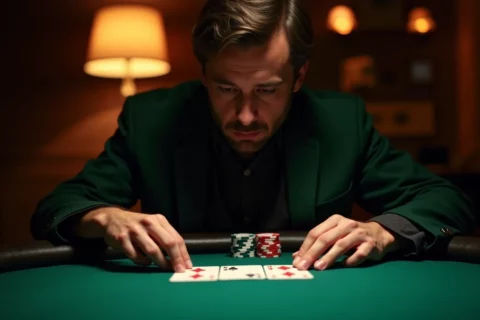

A grinder running eight tables does not play poker; they run a workflow. Every open to 2.5x, every 33 percent c-bet on dry flops, every instant fold to a check-raise in a marginal spot are not decisions. They are keystrokes in a system designed for throughput, not precision. Profit comes from volume, and volume demands standardization. Standardization leaves fingerprints. Fast fingers and fixed patterns broadcast exactly where a player’s autopilot lives and, more importantly, where it cracks.
The edge against these opponents has nothing to do with calling them bots. Mechanical play is not software. It is a human coping with limited attention, and humans overload. The money sits in spotting the rhythm change, the moment when the workflow collides with reality and the grinder’s timing tells you they are no longer on rails.
Reading the Factory Floor
Multi-tablers simplify to survive. A fixed preflop open size from every position erases one decision tree. A c-bet frequency locked at 75 percent across board textures removes postflop branching. Quick folds to 3-bets out of position and instant give-ups on scary turns conserve seconds that add up across hundreds of hands per hour.
These patterns are not inherently weak. Many are solid, population-exploitative defaults that print against straightforward opposition. The problem for the multi-tabler is inflexibility. Their 33 percent c-bet on a coordinated board is not a choice; it is a setting. When you recognize which actions are protected by rehearsed competence and which are mere automation, you know where to apply pressure.
Watch for the absence of positional adjustment. A one-table regular varies open sizes, 3-bet frequencies, and continuation strategies based on stack depth, opponent tendencies, and table flow. The eight-tabling grinder often does not. Their early position and cutoff play blur together because nuance costs bandwidth they do not have.
When the Metronome Skips
Rhythm changes expose the human underneath the machinery. A player who snap-acts for forty minutes then tanks for fifteen seconds in a small pot is telling you something. Their tables have collided. Perhaps they have wandered into a spot their defaults do not cover. Or they are simply distracted, processing action elsewhere while their time bank bleeds.
Repeated late actions followed by simple folds are another tell. Using 80 percent of the clock to fold to a single bet suggests table overload, not deep thought. The decision was probably made in the first three seconds. The delay was spent locating the cursor.
Sudden snap-calls in complex river spots can signal a predetermined surrender to pressure. A grinder who typically pauses briefly before calling suddenly insta-calls a large bet may have decided “call any” two streets ago and stopped processing new information. Conversely, an uncharacteristic tank followed by a min-raise or weak call often means their routine broke down and they improvised badly.
Time bank use on one table while others run hot is particularly revealing. If a player sits for their full allotment on a single decision while action piles up elsewhere, that spot has consumed their entire cognitive budget. They are not balanced there. They are solving, and solvers under pressure make readable mistakes.
Solid Defaults versus Collapse Points
Not all automation is exploitable. Some of it is good. The key is distinguishing protected habits from fragile ones.
Solid defaults show consistent timing and sizing in common scenarios. A grinder who always opens 2.5x and always c-bets 33 percent on K-7-2 rainbow is not necessarily leaking. They have a reasonable strategy for a frequent spot and execute it without thought. Attacking these habits blindly is tilting at windmills.
Collapse points appear when unusual demands break the pattern. Faced with a large overbet or an unexpected check-raise line, the multi-tabler may respond with bizarre sizing, 10 percent pot or 150 percent pot, that screams no prepared response. Their timing shifts dramatically. They tank, then emit a weak play that does not match the thought they pretended to have.
Watch how they handle non-standard aggression. A delayed c-bet from out of position, a triple-barrel with unconventional sizing, a check-raise on a wet board when they rarely check-raise at all, these lines force improvisation. The one-table regular adjusts in real time. The overloaded grinder often either folds too much or spazzes with uncharacteristic aggression because their system has no slot for this input.
The Bot Trap
Mechanical timing alone proves nothing. Accusing organized opponents of automation based on fast folds and fixed sizing is a leak in itself. Bots do not tank when tables collide. Bots do not suddenly vary bet sizing after ten seconds of hesitation. Bots do not show rhythm changes at all.
The exploitation target is workload strain, not efficiency itself. A grinder playing six tables well is dangerous. The same grinder at twelve tables, with action overlapping and time banks draining, becomes a different animal. Their tells are not in their speed. Their tells are in the variance of their speed, the moments when human limits intrude on mechanical process.
Attentive one-table regulars deliberately vary timing and sizing to manipulate perception. They project strength with quick bets, weakness with pauses, mixing these signals to exploit reads. Multi-tablers cannot afford this theater. Their timing is functional, not performative. When it shifts, it is not deception; it is distress.
Building the Counter-Strategy
Against a grinder whose patterns you have catalogued, apply pressure at the seams. Probe with unusual lines in spots where their defaults are rigid but weak. Float the turn when they give up predictably. Overbet rivers when their snap-call threshold looks predetermined. Check-raise their c-bets on boards where their 33 percent probe is pure automation, not conviction.
Most importantly, note the timing. A player who acts in 1.2 seconds for an hour then takes 8.4 seconds and emits a strange size is not balanced. They are exposed. The number on the clock matters less than the deviation from their own norm.
Volume players built their edge on efficiency. Your edge comes from knowing exactly what that efficiency costs them.