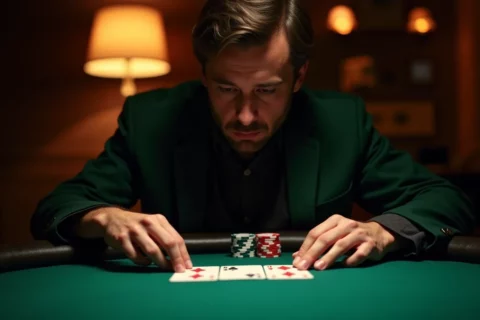

A regular on GGPoker’s Spin & Gold tables recently finished third on a daily leaderboard and posted his screenshot to a forum. The replies congratulated him. Nobody asked the obvious question: how many hours did he burn getting there, and what did his cashier look like before the bonus hit? The leaderboard paid him $340. His table results for those fourteen hours were minus $510. He had played six tables simultaneously for the final four hours, well past the point where his decision-making flattened into autopilot. The room got exactly what it wanted: a body keeping games active through the dead hours. He got a trophy that cost him $170.
Poker rooms structure promotions with surgical precision. Daily leaderboards reset at midnight, missions expire in twenty-four hours, and tier systems dangle incremental rewards just beyond your current volume. The architecture is mechanical, not malicious. The room needs liquidity at 4 AM, traffic in formats that run thin, and rake generation that compounds regardless of who wins the pots. Your incentive alignment with the house is partial at best, and money disappears in the gap between those interests.
The Illusion of Rake Reduction
Some promotions genuinely cut your costs. Fixed rakeback programs like GGPoker’s Platinum tiers in the Fish Buffet deliver predictable percentages, 35% to 60% depending on rank, with no format restrictions or volume traps. A player generating $1,000 in monthly rake at Platinum Whale recovers $600. This directly reduces playing costs; it is clean and calculable.
Most promotions are not like this. Leaderboards for Hold’em, Omaha, Short Deck, or All-in-or-Fold pool prizes among top finishers based on points tied to rake paid or hands played. The expected value collapses for anyone outside the top ten percent. A daily Spin & Gold board might distribute $5,000 across five hundred players, but $3,800 of that goes to the top five. The remaining field grinds extra volume, pays extra rake, and subsidizes the winners. The room collects the surplus.
Missions operate similarly. GGPoker’s “Honeymoon for Newcomers” sequences thirty days of tasks, some trivial, some requiring specific showdowns or format switches. The rewards, tickets and small cash bonuses, carry play-through requirements or conversion uncertainty. A $10 tournament ticket is not $10. It is a lottery ticket with a distribution of outcomes, many of them zero.
The Hidden Arithmetic of Net Hourly Value
Calculating true profitability requires collapsing everything into one number: net hourly value. Start with your baseline. Tracking software gives you a win rate in bb/100 or dollars per hour at your standard game, stake, and table count. That number is already post-rake, already reflective of your actual skill edge.
Now add the promotion. Estimate your expected finish and payout based on historical leaderboards and your projected volume. Convert tickets to realistic cash equivalents, not face value. A $25 Spin & Gold ticket that you cash thirty percent of the time is worth $7.50, less the time spent playing it.
Subtract the additional rake generated by extra volume. If you normally play 500 hands daily and push to 1,200 for a leaderboard, the incremental 700 hands carry full rake. At 5bb/100 average rake, that is 35bb in added cost. Scale across a week.
Factor the fatigue decay. Track your own pattern. Many players see win rates drop 2bb/100 after hour four, then 5bb/100 after hour six, then negative. Extending from four hours to eight does not halve your hourly. It inverts it. Four hours at +8bb/100 earns more than eight hours at +3bb/100 collapsing to -2bb/100.
The formula is simple in structure, brutal in application. Net hourly value equals table winnings plus promotion expected value minus extra rake minus fatigue cost, all divided by hours played. A positive number means the promotion served you. A negative number means you served the room.
Format Traps and Session Bloat
Leaderboards push players into specific ecosystems. A cash game specialist with a population read on 6-max NL100 finds himself in Spin & Gold, where edge is thinner, variance is violent, and the structure rewards volume over precision. Or he sits All-in-or-Fold tables, a format that erases postflop skill entirely. The points accumulate, but the win rate evaporates.
Session extension is subtler and more personal. The leaderboard resets at midnight. You are thirty points from a tier jump at 11 PM. Your last three hours have been flat, marginal calls creeping in, timing tells slipping. The rational move is to close and sleep. The promotion demands continuation. Those final ninety minutes cost more than the tier pays.
Adding tables beyond your capacity produces a similar decay. Four tables might be your optimal, where you catch timing tells, note bet sizing patterns, and exploit population leaks. At eight tables, you become a script with thumbs, folding too tight, missing value bets, and failing to isolate weak players. The room collects rake on sixteen extra hands per orbit. You collect mistakes.
Selective Engagement as Edge
Disciplined players treat promotions as optional, not obligatory. The filter is strict: does this reduce my net cost of playing without changing how I play?
Fixed rakeback passes. Low-barrier missions that align with existing volume pass. A “play 100 hands of NLH” mission when you already play 2,000 daily is free money. A “win three All-in-or-Fold pots” mission when you never touch the format is a trap disguised as a gift.
Volume leaderboards fail unless you have specific intelligence. Know the typical winning score. Know your hourly at the required format. Calculate the probability of finishing in a paying position given your available hours. Most players skip this step and trust the dopamine of point accumulation.
The guiding principle is ownership of your customer profile. The room wants you active, multi-tabling, format-agnostic, and time-insensitive. Your interest is the opposite: selective, focused, format-specific, and sharply aware of when performance degrades. Accept only the promotions that bridge toward your profile, never the ones that drag you toward theirs.
The forum regular with his $340 leaderboard finish and his $170 net loss played again the next day. The board reset. The points were cheap for the first six hours, he told himself. He could pace it better this time. The room had his number. The trophy was the hook. The session was the cost.