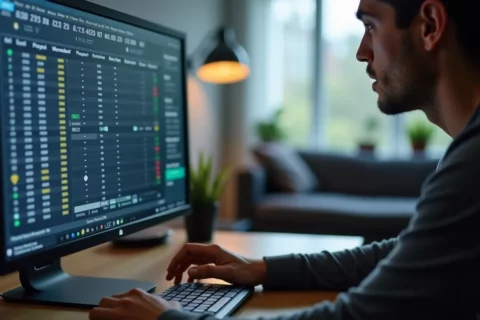
The spreadsheet crowd lost their safety net, and most of them never learned to swim. When Partypoker stripped away local hand-history downloads and blacklisted most third-party software in 2019, the panic was immediate and revealing. Regulars who had built careers on 50,000-hand databases suddenly discovered they could not identify a river overbet without a popup telling them whether it was “standard” or “exploitative.” That same dependency has now spread across Unibet’s deliberately blind lobbies and CoinPoker’s 2026 terms, which ban external HUDs and opponent overlays outright while keeping only platform-integrated tools. The game became a test of who was actually paying attention.
What HUD-Free Actually Changes
Partypoker’s ecology overhaul killed the download pipeline that fed tracking databases. Unibet went further from day one, designing an environment where aliases rotate, lobbies hide player names until you sit, and no hand history leaves the client. CoinPoker’s 2026 terms complete the arc by prohibiting third-party analysis overlays entirely. This is not hostility to skill but hostility to a specific kind of laziness: the reg who auto-imports, auto-reviews, and auto-labels without ever watching the actual table.
These rooms still reward reads. They simply punish the player who outsources observation to software. A HUD tells you that Villain’s river aggression frequency is 34% over 12,000 hands. It does not tell you that Villain just time-banked for fifteen seconds before jamming, that his bet sizing shrank from 75% pot to 33% on the turn, or that he showed up with a missed flush draw in a spot where his range should have been polarized. Aggregated statistics smooth away the texture that makes money in real time.
The Manual Note System That Works
Forget “fish,” “nit,” and “maniac.” Those labels are intellectual shortcuts that become mental prisons. Once you tag someone a fish, you start interpreting every weird line as proof of incompetence rather than asking what they actually hold. Confirmation bias sets in, and you miss the adjustments they make, the hands they show down, the spots where they outplay you.
Replace categories with decisions. A working note looks like this: “Called 3-bet OOP with A5s, folded to flop c-bet on K-high board.” Another: “Small river lead on four-straight board, showed bluff.” Or: “Time-bank jam on river, tabled missed gutshot.” Each entry captures a specific choice in a specific context. It is actionable immediately, testable against future hands, and immune to the staleness that infects static labels.
The discipline is simple. Watch hands you have folded. Note bet sizing patterns by street. Record timing tells without inventing stories to explain them. When showdown comes, reverse-engineer the line: what did they do preflop, on each street, and what does that sequence reveal about their range construction? Categorize by situation rather than by player type. “Over-calls turn raises on coordinated boards” beats “loose” every time.
What Spreadsheet Regulars Overlook
HUD-dependent players in HUD-free environments face a predictable collapse. Stripped of their VPIP and PFR popups, many revert to population-level default strategies that ignore the actual opponents in front of them. They play “standard” lines against players who have already revealed themselves through dozens of in-session decisions. They miss the tilted reg who suddenly starts overbetting rivers after a bad beat. They miss the recreational player who leads small with blockers because he saw it on a stream once and thinks it is sophisticated.
The edge goes to the observer who treats every hand as data collection. While the HUD refugee waits for a sample size that will never arrive, the manual reader has already catalogued three bet-sizing tells, two timing patterns, and one showdown hand that redefines an opponent’s river range. That information compounds within a single session. By hour two, the manual reader knows who folds too much to turn pressure, who cannot resist min-raising the river with the nuts, and who time-banks every bluff but snap-calls with second pair.
Building the Habit
Start with one table if you must. After folding, do not open another lobby or scroll your phone. Watch the hand play out. Ask yourself: what would I do with each player’s cards? What does their actual line suggest they hold? When the cards are shown, compare your reconstruction to reality. The gap between them is your learning edge.
Prioritize showdown hands above all else. They are the only moments where your reads face ground truth. A player who check-raises the turn with 87o on a K-high board is telling you something about his value-bluff ratio that no HUD could capture in fewer than thousands of hands. A player who insta-jams the river after a long tank on the turn is revealing timing patterns that aggregate statistics bury in averages.
Focus on bet sizing above speed. Sizing is deliberate, chosen, informative. Timing can be connection lag, distraction, or multi-tabling friction. When both align, note them together. “Long tank, then 30% pot river lead” carries more weight than either tell alone.
The Sustainable Edge
The complaint that HUD restrictions protect casual players while punishing serious ones misses the point entirely. Serious study has never required external databases. It requires attention, pattern recognition, and the humility to update your reads when evidence contradicts them. The player who develops these skills in HUD-free rooms carries them everywhere: to live games, to new platforms, to formats that have not been invented yet.
CoinPoker’s 2026 terms are not a handicap. They are a filter. They separate players who understand poker as a game of observation from players who understand it as a game of database management. The first group spots leaks in real time, adapts within orbits, and builds reads that improve as the session deepens. The second group waits for imports that never come, playing blind against opponents they never bothered to watch.
The tables are softer than they look. The regulars who relied on spreadsheets are bleeding edge they never earned. The opportunity belongs to anyone willing to do the actual work of looking.